
How One Employer’s Search for a Better Way Became a Mission That Changed Thousands of Lives
Every year, employers across America face the same question: Who is going to do the work?

Scott Evans, FEWA President and Founder.
From landscape companies and nurseries, farmers, ranchers, to seafood processors, hospitality businesses, forestry operations, construction companies, amusement parks, golf courses and other seasonal employers, thousands of businesses depend on temporary workers to fill jobs that keep their operations moving.
Before they can hire a single foreign worker through the federal guest worker H-2A or H-2B programs, however, they must first advertise those jobs in the United States and demonstrate that qualified U.S. workers are unavailable to fill them.
For C. Scott Evans, that challenge wasn’t a policy debate. It was reality.
Long before he founded the Federation of Employers and Workers of America (FEWA), Scott was a landscape contractor in Bay City, Texas, trying to solve the same workforce challenges facing employers across the country today. What began as one business owner’s determination to find a legal, dependable workforce would eventually grow into one of the nation’s most respected employer/worker associations serving seasonal industries.
But the story of FEWA didn’t begin in a boardroom. It began with a boy looking for his first job.
A Week Without Pay
Scott was just 12 years old when he walked into Walker Seed & Garden Center Company in Bay City and asked for work. There was only one problem. No one was hiring kids his age. So Scott made an offer.
“Let me work for a week,” he said. “If you like my work, then hire me. If you don’t, you don’t have to pay me.”

Scott Evans (left) with FEWA COO Arnulfo Hinojosa, (center) and FEWA Board Member Tim Clark, during the TNLA ceremony where Scott was honored with the Award of Recognition Program (ARP).
The gamble paid off. His first assignment wasn’t glamorous. Long before weed eaters became common, Scott spent his summers pushing a lawn mower around every headstone in a local cemetery. When he finished mowing the entire cemetery, he started over mowing around each of the hundreds of gravestones.
It wasn’t exciting work. It was simply honest work. That experience shaped something far more valuable than a paycheck. It instilled a work ethic that would define the rest of his life.
Growing up in the small Texas town of Bay City, Scott learned early that success wasn’t handed to anyone. It was earned one customer and one job at a time. That lesson never left him.
Growing More Than Trees
Scott’s love for horticulture began while he was still a teenager.
Working around plants and trees sparked a fascination that eventually led him to Texas A&M University, where he earned his degree in horticulture. Even as a student, he was thinking ahead.
During football season, while thousands of fans filled Kyle Field, Scott gathered live oak acorns from the university campus. Years later, those acorns would become magnificent trees growing throughout Texas—including many that now line the stadium at the university where he once collected them.
After graduation, Scott worked briefly for a large landscape maintenance company where he started its landscape construction division in Houston before returning home to Bay City with a vision of building something of his own. He purchased the landscape construction division of the same company that had given him his first job as a boy. Scott & Company Landscape was born.

A 1989 photo of the first conpany Scott Evans owned: Scott and Company Landscape, Bay City, Texas.
The business flourished, eventually employing dozens of people while earning a reputation for quality throughout the region. At the same time, Scott pursued another lifelong passion by developing Rancho Encino Tree Farm, a wholesale nursery specializing in container-grown trees that still continues to supply projects across Texas.
By every measure, he had built a successful career. Most entrepreneurs would have been content. Scott wasn’t.
An Industry Leader
As his business grew, so did his involvement in the green industry. Scott believed that strong industries required strong associations.
He became deeply involved in the Texas Association of Landscape Contractors (TALC), eventually serving as its chairman during one of the organization’s most significant moments—its merger with the Texas Nursery Association to form today’s Texas Nursery & Landscape Association (TNLA).
His leadership didn’t stop there. Over the next two decades, he served in numerous leadership roles, including more than 10 years with the Texas Nursery & Landscape Foundation, where he championed scholarships, internships and leadership development for future industry professionals. His vision helped launch initiatives that continue to prepare the next generation of leaders while expanding educational opportunities for horticulture students.

Scott Evans addresses the Texas Nursery and Landscape Association audience after receiving the prestigious ARP Award in January 2026.
In January 2026, TNLA recognized Scott’s lifetime of service by presenting him with the prestigious Arp Award, one of the association’s highest honors. Yet those who know Scott best rarely begin by talking about awards. They talk about his character.
“What can you possibly say about Scott Evans in five minutes?” longtime friend and fellow industry leader Paul S. Tomaso asked during the award presentation. “Absolutely nothing–at least nothing that does him justice.”
Tomaso described a man whose “quiet humility and unassuming nature always shift the focus away from himself and toward the goals, people and organizations he works so hard to uplift.”That observation would prove true again and again. Because while Scott was leading an industry, another challenge was quietly changing the direction of his life.
The Question That Changed Everything
Like many seasonal employers, Scott depended on a reliable workforce. He followed the rules. He hired available American workers. He worked hard to build a successful business.

FEWA’s first Board of Directors meeting in 2001. From left: Scott Evans, FEWA; Lamar Evans, Walker-Evans Landscape Company; Joe Palimeno, Ledden Palimeno Landscape; and Duane Keesen, Keesen Landscape.
Yet finding enough employees willing to perform demanding seasonal work became increasingly difficult.
He realized there had to be a better way–not only for employers struggling to find a legal workforce after demonstrating no qualified U.S. workers were available, but also for the temporary workers who simply wanted the opportunity to earn an honest living through lawful employment.
Instead of accepting the system as it was, Scott did what he had done his entire life. He started learning. For nearly three years, he immersed himself in one of the most complicated areas of federal employment law.
He traveled to Washington, D.C., meeting with government agencies. He visited U.S. Consulates in Mexico. He studied regulations, researched procedures and pieced together a process that few people fully understood at the time.
The H-2 programs involved multiple federal agencies, layers of regulations and countless procedural requirements. Many employers found the process unworkable and overwhelming.
Scott saw an opportunity. Not to build a business. But to solve a problem.
And, as had happened years earlier when a 12-year-old boy offered to work for free just to prove himself, he wasn’t thinking only about starting his own company. He began helping a handful of fellow employers navigate the process.
Those first five employers–friends from across the country who faced the same workforce challenges–had no way of knowing they were witnessing the beginning of something much larger. What started as one landscape contractor sharing knowledge with a few colleagues would soon evolve into a national movement built on a simple idea: When employers succeed, the workers they legally employ succeed as well.

FEWA staff at the association’s 2005 annual team meeting.
Building More Than an Association
The handful of employers Scott Evans began helping had one thing in common. They weren’t looking for shortcuts. They weren’t looking to avoid the law. They simply wanted to hire temporary workers legally after demonstrating they could not find qualified U.S. workers to fill essential seasonal positions.
Scott understood their frustration because he had lived it himself. As he shared what he had learned, word spread. More employers called. More questions came. More businesses found themselves facing the same complicated federal process.
It quickly became clear that this wasn’t a problem one company could solve alone. It required something bigger. It required an organization.
Building an Association, Not a Business
Scott’s first step was helping establish the National H-2B Users Association, an organization dedicated to helping employers better understand the H-2B program and remain in compliance with its ever-changing regulations.
But even that wasn’t enough. The more Scott learned, the more he realized something was missing. There were companies beginning to process paperwork following the path Scott had established with the various federal government agencies. But there was little concern for the well being and care of the workers.
There wasn’t an organization built around the foreign employees and employers’ long-term success. So Scott did what he’s done throughout his career. He built the organization he wished had existed.
The Federation of Employers and Workers of America wasn’t created to process applications and take employers’ and workers’ money. It was created to serve worker and employer members.
From the beginning, FEWA operated differently. Rather than treating each filing as another transaction, the association focused on building lasting relationships with employers whose businesses depended on a legal, reliable seasonal workforce. Every prospective employer was carefully evaluated to determine whether the H-2A or H-2B programs were the right fit. If they weren’t, FEWA staff let them know.
That approach wasn’t always the easiest. It was, however, the right one.
“We pre-qualify employers,” Scott explained. “We don’t just file applications and let the government decide whether they qualify. That’s not serving the employer.”
That philosophy still defines FEWA today.
Investing in People
One of Scott’s earliest hires says as much about his leadership as any business accomplishment. A young woman working for Scott encouraged a college classmate to apply for a job. His name was Arnulfo Hinojosa. He was 19 years old. Still in college.
Scott saw something in the young man that couldn’t be measured on a résumé. He saw maturity. Character. Potential.
Nearly 25 years later, Arnulfo serves as FEWA’s Chief Operating Officer. The organization Scott founded has become as much Arnulfo’s life’s work as his own. Looking back, Arnulfo sees the same leadership qualities today that he saw as a college student.
“Scott never built FEWA to become the biggest organization in our industry. He built it to do what was right,” Arnulfo explained.

Scott Evans (left) and Arnulfo Hinojosa (right) with FEWA’s Monterrey, Mexico team.
“For nearly 25 years, I’ve watched him make decisions based on one simple question: ‘What’s best for our employer and worker members?’ He also believes the temporary workers those employers legally hire deserve to be treated with dignity and respect. That philosophy has shaped our FEWA culture, our team and the thousands of lives we’ve touched. I’m grateful he took a chance on a 19-year-old college student. It changed the course of my life,” Arnulfo added.
That investment in people became one of Scott’s defining characteristics. The same can be said for FEWA’s long-time staff. Many have spent well over a decade with the organization. Several have been there since the beginning.
For Scott, that isn’t an accident. It’s a reflection of culture. People stay where they know they matter.
Doing Things the Right Way
Over the years, FEWA has grown far beyond its roots in the landscape industry. Today, employer members represent a wide range of seasonal industries that depend on temporary seasonal labor. While industries differ, the challenge is remarkably similar. Businesses need people.
Before they can legally hire temporary foreign workers, they must first recruit U.S. workers and demonstrate that qualified domestic workers are unavailable. Only then can they participate in the H-2A or H-2B programs. Scott has never viewed that process as an obstacle. He views it as a responsibility.
Throughout his career, he has believed employers deserve a legal workforce solution they can trust—and that the temporary workers they legally employ deserve honesty, fairness and respect. Those ideas aren’t competing values. They’re complementary ones.
As Scott often reminds his team, every worker is somebody’s son, somebody’s daughter, somebody’s father or somebody’s mother. That perspective has helped shape FEWA into something far different than a filing service. It has become a trusted partner.
A Legacy of Leadership
Scott’s influence extends well beyond FEWA.
In addition to decades of service within the Texas Nursery and Landscape Association, he helped establish leadership development initiatives, expand scholarship opportunities for students pursuing careers in horticulture and strengthen one of the nation’s most respected state industry associations. Those accomplishments earned him recognition.
But anyone who has spent time with Scott knows he rarely talks about awards. Instead, he talks about employers, workers and FEWA’s staff.

Pam and Scott Evans.
He talks about Pam, his wife of almost four decades, whose encouragement and partnership have been central to every chapter of his journey. He talks about the future.
Even now, approaching FEWA’s 25th anniversary, Scott spends less time looking back at what he has accomplished than thinking about what still needs to be done—whether that means making the guest worker programs work better, helping employers succeed, creating opportunities or simply doing things the right way. That same instinct to see a need and find a way to meet it has extended far beyond FEWA.
Establishing a Jump Start
In 1996, Scott and Pam were visiting Yellowstone National Park with longtime friends Beverly and Cal Medhaug when a conversation at the Old Faithful Inn turned to the challenges facing young Native Americans.
Rather than simply talk about the problem, the two couples decided to help create opportunities through meaningful summer internships. Using their contacts, they secured positions for four young people from the Rosebud Reservation in South Dakota.
They quickly discovered, however, that getting the job was only the first hurdle. A young person might have an internship waiting but no money to get there—or need work clothes, tools, transportation, food or enough money to make it to that first paycheck.
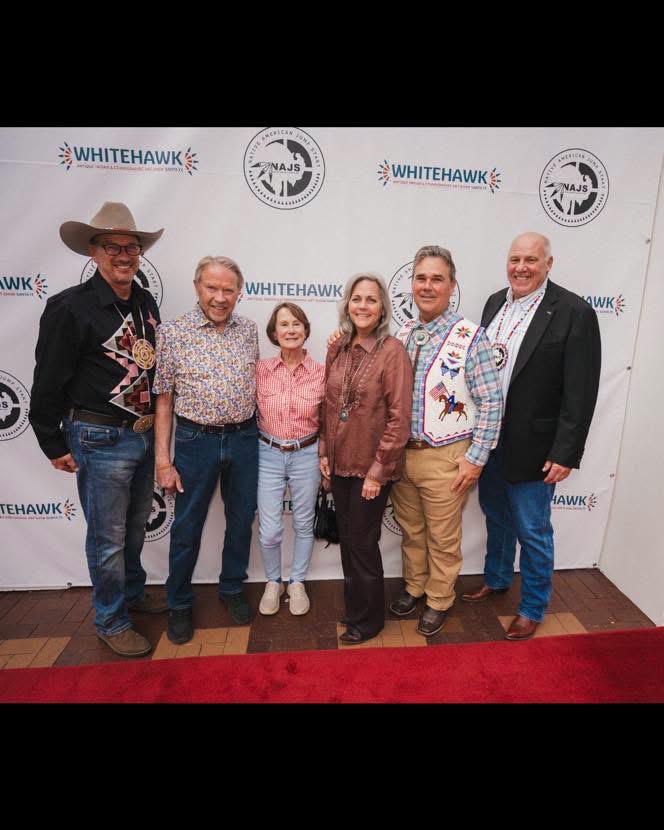
Pam and Scott Evans (right), co-founders of Native American Jump Start with other team members.
That realization led to the Jump Start Grant Program, providing the practical financial bridge needed to turn an opportunity into reality. What began with four interns grew to include both employment and educational assistance, with much of the early work administered by Scott and Pam from their kitchen table in Bay City, Texas.
Today, Native American Jump Start is a Wyoming-based 501(c)(3) nonprofit dedicated to creating opportunities for Native American individuals and families through education and employment.
Since its beginnings, the organization has provided more than $1 million in financial assistance to more than 1,000 Native American students and job seekers. Scott continues to serve as co-founder, board member and volunteer—another example of his longstanding belief that sometimes changing a life begins simply by giving someone the opportunity to take that next step.
A Stadium Worth Filling
Ask Scott what makes him most proud, and you might expect him to mention founding FEWA or Native American Jump Start. Or building successful businesses. Or receiving one of the highest honors in the green industry.
He won’t. Instead, he’ll tell you about a football stadium.

Scott Evans and FEWA staff visit employees of the Rancho Encino Tree Farm.
Years ago, Scott realized that if every temporary worker FEWA had helped legally come to the United States to work for one of its employer members sat together in one place, they would fill an entire professional sports stadium.
To Scott, those aren’t worker visa numbers. They represent employers who found the workforce they needed to continue serving their customers and growing their businesses.
The seasonal workers are men and women who had the opportunity to earn an honest living which paid much more than they could earn in their home country through legal employment and return home to support their families. They represent relationships built on trust.
That’s not just the story of Scott Evans. It’s the story of FEWA. And if Scott has his way, it’s a story that will continue for generations to come.